

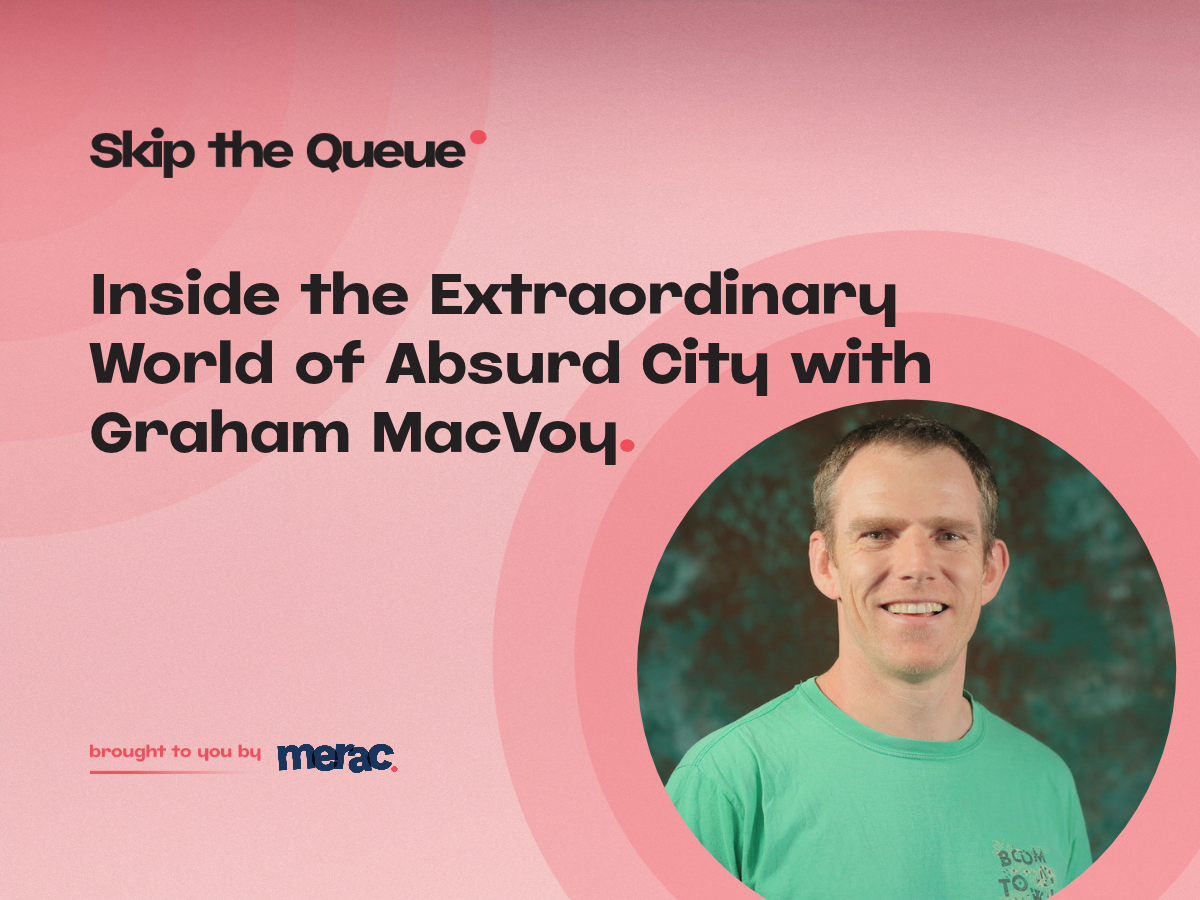
In this Skip the Queue podcast episode, Andy Povey is joined by Graham MacVoy co founder & CEO, Wake the Tiger at the Land, Leisure & Tourism Show to explore the creation of Absurd City at Westfield London. Graham shares the creative thinking behind the immersive experience, the challenges of bringing a new attraction to life, and how storytelling, sustainability and visitor interaction shape the Wake the Tiger experience.


Topics Discussed
- The story and creative vision behind Wake the Tiger and Absurd City
- Bringing an immersive attraction to Westfield London
- Storytelling, world-building and visitor interaction
- Sustainability, upcycling and ethical business practices
- Achieving and maintaining B Corp status
- Lessons learned from developing the Bristol and London experiences
- Managing visitor flow and creating freedom to explore
- Future plans, improvements and new creative ideas

Show references:
Graham MacVoy – Co founder & CEO, Wake the Tiger
Land Leisure & Tourism Show
4 – 5 November, 2026 | NEC, Birmingham

Transcript
Andy Povey: Mind bending, provocative and nostalgic. That’s how I describe Absurd City, the brand new Wake the Tiger experience that’s just opened in Westfield, West London. I was lucky enough to have a look around as it opened its doors for the first time and honestly, wow, the level of detail, craftsmanship and storytelling is incredible. There’s just so much going on. It’s even better when you get to experience it for yourself. Now, today I’m at the Land Leisure and Tourism show here in Birmingham. I’m really excited to be joined by one of the creative brains behind Wake the Tiger, Graham MacVoy. Welcome to Skip the Queue, the podcast for people working in and with visitor attractions, brought to you by Merac. I’m your host, Andy Povey and I’m joined by Graham MacVoy from Wake the Tiger.
Andy Povey: Graham, you’ve just opened in London. Just opened Absurd City in Westfield in West London. For those people listening who don’t know what Wake the Tiger is, I wonder if you can just give a quick intro.
Graham MacVoy: Cool. So well, we opened our first park in July 22 in Bristol off the back of COVID and our background was in music festivals and I worked in many music festivals for years and joined the Boomtown team in 2017 and it became site and operations director. Got really close with the two founders and Covid hit. We had a warehouse in Bristol and we’d always wanted to do something that was for all demographics all year round, bit more permanent rather than for 60,000 ravers on a weekend. And just to bring that creativity to a wider audience. And so we opened Bristol in ’22 and that went really well and that was almost like a pilot really. See, and it went really well. So the intention was to open something in London and the park itself is.
Read more
Graham MacVoy: We call it an immersive art experience or coined the phrase Amazement Park. It’s quite ethereal, surreal, like you sort of step for a portal into another world that is a combination of. Of art, storytelling, messaging, but no real objective to it, which some people absolutely love. And some people get really thrown back and they’re like, what do we do here? But if you sort of sink into it because we don’t preach any messages that we don’t believe that’s how things land. There’s lots of sort of just themes and stuff to jar interest or make you look at the world differently, sort of seep through it all. And actually when we.
Graham MacVoy: So we did the first one and we did it off of a paragraph of a world building, this world of Meridia, this dystopian world in a post apocalyptical state, post climate crisis and we created this place that these survivors were creative people were trying to bring life back to their world. And Absurd City is part of the same world, part of the sort of the storytelling and it, but it’s a different venue, a different place in this world. The sort of capital city of Dome City where some of the inhabitants are trying to maintain their life as it was in terms of consumerism and data and others are trying to bring equilibrium back to it if you like. So there’s definitely a better story thread through it. There’s art and interaction as well.
Graham MacVoy: So it’s a bit of a mixed pot really. But we’re really proud of what it is that we’ve created.
Andy Povey: So you should be. I went to Bristol over the summer and that was my first experience and I think it took me about 24 hours to digest what I just experienced. But that was a real positive. It really made me think, really made me consider fantastic experience. So Westfield Shopping Centre, for those of you who don’t know West London particularly well is in White City is one of the most high end shopping centers I suppose in the uUK. Why did you choose that?
Graham MacVoy: Europe I think. Well we’ve been looking for a site for, I can’t remember now, nine months or something and when you’re looking for sites quite specific, you want good transport links, needs to be the right footfall, right square footage, right ceiling height, etc. There’s a whole list of things and we’d seen all sorts and you don’t get the perfect site either. But nothing quite ticked the box. But we knew we wanted to do this city, this dorm city and we knew we wanted to do it a bit like we do at Boom Town with the different districts and split that out and it was actually Westfield that got in touch with us rather than the other way around because they didn’t even put it on the market.
Graham MacVoy: And went and Luke and I, and who’s my business partner, we’re not really too sure about going to a shopping centre. I’ve go to shopping centre, I don’t even shop. Right.
Andy Povey: That’s what the Internet’s for.
Graham MacVoy: Yeah, I just don’t, I hate it. It stresses me out. But the, and he’s like, you need to come and see this. We hadn’t heard of Kidsania either. We, you know, you need to come and see this. And we walked in and, like, our jaws hit the floor. We wanted to build a city with shops and streets and. And it was literally there.
Andy Povey: Yeah.
Graham MacVoy: And we couldn’t believe it.
Andy Povey: I mean, it is just a box on top of a shopping center, isn’t it?
Graham MacVoy: Yeah. Massive box,.
Andy Povey: Massive box.
Graham MacVoy: Yeah. And so we sort of sat with it, not for long, and we moved. And, you know, at the same time, I think it was a. It was a big sort of risk, if you like, for Westfield as well, like a global company. And were effectively a startup. We’d been trading three years in an industrial estate behind the train station in Bristol. Completely different to anything else that’s going on. So they had to take. They’ve taken a gamble with. With us as well,
Andy Povey: I‘m sure. Yeah.
Graham MacVoy: But we fitted into that space really well and could use a lot. We saved them a lot of money on rip out because we wanted to keep quite a lot of the stuff.
Andy Povey: In that whole sort of shopping centre, reuse of shopping centres, then it’s a real positive story across the industry.
Graham MacVoy: Could be.
Andy Povey: Could be. It will be positive.
Graham MacVoy: Yeah, yeah. It will be.
Andy Povey: Environmental concerns are really important for you. How do you balance that against running a visitor attraction that is all about consumption?
Graham MacVoy: I think there’s a different thing. You’ve got the project to the build and how you build something, and then you’ve got how you operate it, both with your products and your stock, but also your actions and your voice. So when we’re building the project, we use as much upcycled or recycled stuff as we can. In both parks, we used a lot, especially, actually, and we recycled so much of Kidzenia from keeping walls to stuff we ripped out, we put elsewhere and reuse. But obviously Westfield’s opposite, Grenfell. Since Grenfell, there’s been huge changes to fire rules. So it was so hard to understand what you could do. And a lot of the. I think still very creative what we’ve done in there, but it was very tempered and how we could do it. So we. We had to use fire rate Timber. Okay.
Graham MacVoy: Same wood, but two and a half times the price, which was really dull. More plasterboard, more. So there’s a lot of fire rating stuff we had to do and then had to learn about how we could dress it to keep that creativity going. Ceilings are challenged. Ceilings are really important to visitor attractions and what you can do in a shopping center where the ceiling is Very limited with sprinklers and all.
Andy Povey: The cable trays, all that kind of stuff.
Graham MacVoy: All that sort of stuff like so. So that made it a lot more challenging than Bristol where we owned the building and we still met regulations but the actual regulations within Westfield are even sometimes know different again. So from the sustainability point of view we used so many props and there was so much stuff we bought. We were like we can’t use that because all the recycled stuff like. So went to loads of car boot sales, Facebook Marketplace, like recycling stuff but because you’ve bought it secondhand, you have no certificate for it and it was all about getting fire certificates. So we had some seats and they were perfectly good couches but we had to get rid of them.
Graham MacVoy: And so that was really frustrating for what we were trying to do when we knew that the couch was perfectly fine but we just didn’t have a bit of paper that said it was okay. And so you multiply that loads of times. But we learned how to work around that and how to deliver it. So there’s making it safe is absolutely critical. But then the sort of. That final dressing layer and the props layer and also reusing as much as you can within that I think was a big part. But then operationally we don’t sell meat in either of our cafes which definitely takes a hit. We take a hit on that but that’s a choice that we’ve done and actually the food in the. In both of them is really great.
Graham MacVoy: But we work with a company called Double Park in Bristol and a company called Das where we sub out the kitchen in London and both of them do some really lovely food and you know, with events it’s a bit different. Some we do put me on with events sometimes because otherwise you know, if you’ve got corporate or whatever. Yeah. But for day to day we don’t. But also like in London the way we’ve got that we have no single use plastic. We use like toast beer. If you’ve heard of toast beer which is. I’d never heard of it. It’s really good. It’s made from toast which they get locally. Oh there’s loads of other things. So many things that they do and in the gift shops again this is definitely hitting our.
Graham MacVoy: Our margins but no crap cheap.
Andy Povey: Plastic.
Graham MacVoy: Plastic stuff. It’s all done by maker or sustainably sourced or locally sourced and we actually got. I was delighted to see in London or we call it the exchange. The gift shop, they had a 92 ethical rating and that’s made up of. And it fluctuates weekly depending on what stocks in the shop. But it’s made up of the amount as recycled, upcycled or sustainable or come from a charity or community makes. So 92% of our stock on opening was from those areas.
Andy Povey: You try to be the only shop that gets anywhere near that, particularly in that environment.
Graham MacVoy: Yeah. And like, we’ve got these amazing cool, like, bum bags that are made from recycled airplane life jackets and they’re really. They’re really cool. And there’s like the tshirts. Some of the tshirts are new but fit maybe 50% but from a sustainable ethical source. But the other half, we work with Oxfam and we buy T shirts from Oxfam. Some are new and some are old and then we get them cleaned properly, like, and then coloured and then reprinted. So we’ve got these T shirts that are still great, but are from Oxfam.
Andy Povey: So you’re upcycling stuff with the charitable intent as well?
Graham MacVoy: Yeah. And then there’s all sorts of other things. Things in there. Yeah. So it’s really good. And it’s Becky who does our commercial stuff and leads on the gift shop stuff’s done an amazing job and doing that and it’s only going to improve and how we do it.
Andy Povey: So on that note, you are the only attraction that I’m aware of that has B Corp status in the UK.
Graham MacVoy: I think so, yeah.
Andy Povey: Yeah. So well done. It’s something we’re looking at within our business as well. So I’m aware it’s quite complicated, but we’re producing software which is quite low environmental impact versus having people in. So.
Graham MacVoy: It was important to me from the moment we incorporated the. The business in March 21. That was one of the first things I wanted to achieve. So we physically couldn’t have got it any quicker than we did because you have to gather data and there’s a process between getting that, but it was really important to us. And the thing about. They’ve actually changed it recently. But the thing about B Corp, it’s not all about environment, that’s a big part of it, but it’s also about how you treat your staff, the. The wages that you pay. So there’s a whole people piece around it as well, but They’ve actually. And every. So you have to renew every three years. So I think we are. I don’t know, Q2 next year or Q3 next year.
Graham MacVoy: We need to go back to the process. But they’ve actually changed the process significantly, which I’m not deep in it, so I don’t know what those changes are, but the. It more aligns with some of the. I don’t know if it’s the ISOs or the something else not quite there, but it’s still different. But it’s really important to me that. That we stay on that path.
Andy Povey: Well, it’s a proper ethical standard, isn’t it? Yeah. And if you want to run your business ethically, then it’s not just about having the label, is it? It’s just doing the right thing because it’s the right thing to do.
Graham MacVoy: Yeah. One of the big things. What the best feeling I get every year, other than when you see reaction, positive reactions from people’s faces when they go through the park or they see something. And if you haven’t seen the Singing Fish in London, I had a hugely positive reaction. My face lit up. They’re amazing. They’re really good. But is when every year we donate 1% of our turnover to charity.
Andy Povey: Fantastic.
Graham MacVoy: And we do three. So we sort of split it so that we’ve got one that’s environmental, one that’s a local and one that’s humanitarian. So we sort of. We split our. But even, you know, if you have tough years, you know, this year was quite tough with the heat wave and the World cup on for visitor attraction.
Graham MacVoy: Maybe not if you were outdoor visitor attraction, but if you’re an indoor visitor attraction, it was pretty tough year. Yeah. And we made the call to do that anyway because it’s so important for what we stand for that we’ll find that money somewhere else to somehow. to make it work.
Andy Povey: Fantastic. I love it. So you’ve operated Bristol for three years before going into.
Graham MacVoy: Just over four when by the time opened Westfield. Yeah.
Andy Povey: So compare and contrast. What did you learn in Bristol that you then did differently in London?
Graham MacVoy: Well, in Lords, I mean, I wish I could do London again. Like, now you’ve done it, you’re just like, oh, God, we could have just done that and that. But top two things, I think, which we still didn’t quite get right, but was try and landing our onboarding. Onboarding and off boarding, which we still need to improve.
Andy Povey: Of staff? Christmas?
Graham MacVoy: Yeah. The experience.
Andy Povey: Right. Okay. Yeah.
Graham MacVoy: And the storytelling, which. They’re all better and we’re tweaking them and they’ll be fine soon. They just. They needed a bit of user testing. Do you know what I mean? But it’s so obvious, isn’t it? Once you. When you do it and you’re like, oh, you know.
Andy Povey: But none of hindsight.
Graham MacVoy: Yeah, but none of these are. They’re not major things. They’re tweaks about a line, a staff member might say, or a sign, you know, or like a bit of video content. It needs to say this, not that. So it’s not. It’s not major stuff. Yeah, it’s just like, oh, how did we miss that? You know? But London has been set up better to be able to make small tweaks to incorporate that, which will be done in the next few weeks. So. Yeah,.
Andy Povey: And I mean, you talk about storytelling. You’ve got a huge story you’re trying to tell. I mean, you sit in this Venn diagram between an art installation, a visitor attraction, and a theatrical performance.
Graham MacVoy: We’ve done it a different way to anyone, I think, that’s ever. I’m aware of. So we started with a paragraph and built a park, but with always the intention of building a world out of that, rather than starting with a comic story or a cartoon and then a TV show or a film or a play and then an amusement park. Or at the end of it, we started with the amazement park at the beginning of this paragraph. But we’re now writing the book of the story of the world, not just in the Dream Factory in Bristol. So book one is the Dream Factory in Bristol. Okay. Yeah. And the protagonist goes there and it’s about all the. The wider story, the wastelands, the pulse caps, the people. So that’s book one.
Graham MacVoy: And then book two is Absurd City in London, because the protagonist eventually heads up there and that’s the second. The second stop. So, yeah, that book’s been written. I hope to have a first draft before Christmas that I can. We can read through and then develop. So the next year, I’m hoping we. We’ve got a. A proper young adult fiction novel.
Andy Povey: I look forward to that one.
Graham MacVoy: Yeah. Yeah, it’s gonna be great. And it’s really fun writing it as well.
Andy Povey: I can imagine. I mean, there’s a sense of fun throughout the whole experience. It’s all about. Well, it’s not all about fun, but there’s a sense of fun running through the whole thing.
Graham MacVoy: Fun and discovery. Yeah. Thoughtfulness, art, creativity. I think that’s what I see in it. Different people see different things.
Andy Povey: Of course. Yeah. So London’s a really big experience. Bristol’s naturally much smaller and it’s entirely freeform. There’s a way, a route you want people to follow. But it never felt like I was being directed around, even when you were showing me around.
Graham MacVoy: Yeah. You can turn left, right, you can go wherever people miss bits. It’s the same in Bristol. There’s a. Gets a little bit more linear towards the end of Bristol, I suppose, but it makes storytelling really hard.
Andy Povey: Yeah,.
Graham MacVoy: Yeah. Like you’re not just batching people through, but it was really important to us to not. Well, it’s quite interesting actually. Human nature in some respects, likes to be told where to go as well.
Andy Povey: Yeah.
Graham MacVoy: And so that also disrupts that feeling. You know, you get some reviews that say you didn’t know what to do, where to go, whatever. I don’t like the fact that they. Maybe if they didn’t give us a good review, obviously I don’t like that. But the idea that it’s a little bit uncomfortable. You’re trying to work things out and it’s not just on a plate for you. And like there is, especially in London, there’s a lot of depth in the story, which you do see for the people that have engaged with the story and got it, you know, that really comes through. And the folks that have just walked through quite quickly and gone, I don’t know, like that was. We’re out in an hour, like, or 20 minutes, like, you know.
Graham MacVoy: Well, I mean, I can’t even show someone round in 40 minutes, so I don’t know how you. You’re out in 20 minutes.
Andy Povey: How do you manage that flow of visitors? How do you make sure that you’ve got staff in the right places?
Graham MacVoy: Well, with Bristol, it’s quite interesting because we’ve got minimal staffing model in Bristol and it sort of self manages, like, especially because it’s free flow. Like if somebody’s busy, you just go on to the next bit or come back. But when were working at our capacities, we started much lower in Bristol and then we sort of increased it over a number of weeks or whatever, up by 5 or up by 10 from 50 every half hour and we got up to 80 and all of a sudden you saw in the reviews just, it was a bit busy. It was a bit busy and we dropped it to 75 and this was three years ago and we’ve sat there ever since and it’s like. Don’t get me wrong, it is ramo this. I mean our August was our best ever month.
Graham MacVoy: It was so busy and the half term just gone was. Was incredible as well. It’s pretty intense down there when it’s like that but. But folk, you know, folks still seem to be getting a lot out of it and the thing is we’re always evolving it so we don’t have huge big capex projects and we shot and we did well. We doubled the size of Bristol in ’24 so that was one. But that was always in the plan. Now we just always do small changes that just continue to evolve it. And we did our thing in the street this year and put this new junk drop in. We change up a couple of rooms a year and just so we just continually sort of tweaking stuff and. And that means it almost if you come back, six months difference. Okay.
Graham MacVoy: A lot of it will be similar but there’ll always be new things. There’ll always be something new.
Andy Povey: If I was to go back to Bristol tomorrow after, if I visited before, there’d still be things that I saw that I hadn’t seen before because there’s just so much content.
Graham MacVoy: There. Yeah,.
Andy Povey: It’s absolutely vast and I think from a personal point of view it took me like half an hour to work out that I didn’t need to follow sides and I could wander around and open doors and touch things which is just not normal.
Graham MacVoy: Yeah. And I mean we sort of suffer for that as well because people don’t know what they can and can’t pull push like so things get broken and because there’s sort of no rules a little bit which is hard but it’s that trying to let go of yourself and just be present. I think is quite a big part of it and which can be hard if you got small kids running around. Yeah, great. I appreciate that but yeah, not everyone sort of gets that.
Andy Povey: No, I mean the people in front of me in Bristol walked around on their phones. They were filming everything. I mean, what are you experiencing? You haven’t paid to come to it. Fully immersive life experience.
Graham MacVoy: But that’s like concerts as well, isn’t it? Just film it. Yeah, but the. Yeah, because we actually looked at doing. Oh, we are indeed A very basic. This is years ago now. Like guide on your phone. And so they built it out in a beta mode. Just really simple. I said, show me it. So went around and went through the portal into the street and I was looking at my phone, I was like, oh yeah, do this. And we got into the first room out of the street and I said we don’t need to do anymore. We’ll never, we’re never ever going to do that. Because I have, I’ve had to look at my phone the whole time.
Andy Povey: Yeah.
Graham MacVoy: And it was just like. Yeah. So. And then when we were planning London for a while we were talking about doing a whole RFID thing in there which is really interesting to gamify it and it gives you a lot of angles to activate as well. But we pulled a plug on it quite early on because we didn’t want people running around collecting points.
Graham MacVoy: Just generally like while the gamification of it’s quite fun and you know, maybe will, maybe something like that might happen occasionally in the future. That’s not what it’s about that goes against this sort of being able to experience it being in a space that’s different, looking at things different and finding surprises and looking at art and into that and engaging with a story and a meaningful. So. But you know, it might be that we just didn’t quite have it right. But the fear of me of just having kids running around like scoring points like I didn’t quite land right.
Andy Povey: No, I can completely understand that. You need to, the kids need to have freedom and they need to engage with what’s in front of them. Not getting into a competitive.
Graham MacVoy: But the markets are really different and we’ve only been open in London for two weeks or so, three weeks. And it’s a tougher market for sure. More, more, let’s call it maybe not tougher, maybe more mature, more experienced market.
Andy Povey: There’s a lot more things to do.
Graham MacVoy: Lot more things to do. And so yeah, we’re making some tweaks. We have got a story trail, story beat through it which is all done through these terminals and you have to find a code or crack and support the rebels, whatever. But it’s quite time consuming, you got to read quite a lot, etc. Etc. So we’re building out different one which will give you a similar outcome or analog quest for families if you like. So you can go around and count the number of singing fish. I don’t know or like the number of whatever it might be, like. And you spells out a letter and if you use a cipher in the cafe, you can uncrack the letter and if you do that, maybe you get a prize in the gift shop. I don’t know.
Andy Povey: Work in progress.
Graham MacVoy: It’s a work in progress. I did it on the train yesterday. Again, it gives families a little bit of things, but what you can also do as well. The other one is very deep in narrative and lower. This one can be quite a lot more light hearted, but you can use it to direct people to engage with certain things that they might not have seen or realised or give them some meaning. So, yeah, we’re working through that at the moment, which is quite an easy fix because we don’t have to physically change anything in the park. We just need to put the structure in, which is.
Andy Povey: It’s a different interpretation. Yeah. Love it. I’m assuming you walked around the show floor. Is there anything you’ve seen out there that is itching and you’ve got your creative juices flowing?
Graham MacVoy: I’ve had a blunder. This, this is quite cool. The, I don’t know what it’s called the bottles. Have you seen the magic drinks things? They’re quite cool, I think. I mean, I think they’re sold in loads of attractions, but they’ve got a magnet or something in them and if you’ve set them on something, it all swirls and it’s.
Andy Povey: Delete them. Yeah.
Graham MacVoy: Oh, it’s like that caught my eyes. I went past, so I thought that was interesting. But obviously quite a lot of this is outdoor stuff, so it’s. Yeah, it’s not,.
Andy Povey: Not this time. There isn’t an outdoor area at Westfield, but.
Graham MacVoy: Not yet.
Andy Povey: Not yet. So two weeks after opening, I suppose it’s too early to talk about what comes next.
Graham MacVoy: I need a holiday.
Andy Povey: Yeah,.
Graham MacVoy: Yeah, yeah. I’m still definitely. And I need to support my family because I’ve been away a lot. But we have plans. Yes, I have a plan, obviously,.
Andy Povey: Of course,.
Graham MacVoy: But what I need to do is ensure the staff are supported that the business is working and there’s loads of tweaks. Like the biggest thing we’re doing at the moment is signage, like all the signage that’s missing.
Andy Povey: Yeah, yeah.
Graham MacVoy: Because we all, you know, it’s so. Well, you don’t need signage then you put 15, 000 people that into a really strange environment and never seen it before and they’re like where are the toilets? How’d you get in? How’d you get out? You know, and you’re like oh so like again not a big one is that. But it’s. Yeah, just stuff going around. But yeah, longer term that, yeah there is a plan but I think I’ve got loads of plans, books and parks and all sorts but I think it’s really seeing how this lands over the next three months and getting the team all set up before we.
Andy Povey: You get the foundation sorted before you move on?
Graham MacVoy: Yeah, I think so.
Andy Povey: I think we’re coming to the end of our time. Has anybody in the audience got anything they want to know from? Graham, can I pass you this?
LLT Show Audience: Hello Graham, just I guess a question. The Bristol site’s been amazing successful but they’re huge investments. When you open up a new site, the London one, what do you do to just kind of reassure yourself that Bristol wasn’t a one off and it’s just not going to fly in London that your big risk is going to come off?
Graham MacVoy: That is a good question. I mean there’s no guarantees really. I mean there was no guarantees that the first one was going to work. So like actually if you sort of go back to the start we were in Covid. I’m pitching for few million quid on a 10 page deck for something that no one’s ever seen before to open it, you know, when the industry was currently shut down and not knowing if you’re going to make any sales with a brand that no one’s heard of and a concept no one understands. So that was mental and if I had the choice I don’t think I’d do it again. But we did and it, but because we were confident in what we did and in the creativity that we had and I’ve never worked for anyone else.
Graham MacVoy: I’ve always just done stuff and this was just the next thing I was doing. So we did that and I don’t know the numbers in Bristol are good and been holding though is like you know they’re really holding steady. Sure they fluctuate a bit but so much that’s weather dependent on holidays like if it’s sunny may have term for example the last two was ’23 and ’24. We probably did call it a thousand a day, whatever, I don’t know. But then this year we did 500. Because the heat wave started on the Friday before half term and it, I mean it just tanked and then for eight weeks it was horrific. Until August hit and then it was like 20% better than our biggest ever sales year. Sales month, sorry, which is almost August.
Graham MacVoy: So like it was, it’s just been a bizarre year. So yeah, I think it was a risk is, I mean it’s a lot of money. Yeah, it’s a lot of pressure for sure and you know, you can’t be certain of anything but I think as long as you sort of are just honest with people, straight up with people, especially the folk that are giving you money and transparent with them on what’s working, what isn’t. Which, you know, we had some tough times in Bristol a good few years ago and I ended up just trimming the budgets, managing it with the bank and they were really impressed with how we managed it. So it’s about managing the business and if you, as long as you.
Graham MacVoy: We think we’ve got the product right that always needs tweaks and the commercials need improving and our marketing I think is quite strong. So yeah, I think the package is good but you still need to make sure you’re taking the right decisions.
LLT Show Audience: In your mind of ideas. Is there any scope for pop up amazement Parks?
Graham MacVoy: No, we actually looked at it a couple of years ago with Winter Wonderland and I went, I did a lot of work actually on different designs and how you can build something of the sort of quality that we would want to put our name to that it’s so expensive. What we do at the Capex on our builds are just so high. I mean, I hate it. I’d love to get them down but the number of layers that you’ve got, it’s not just like. Because some of the stuff we did and we just got a production company in to do a bit and yeah, it was expensive but it was like there you go, pop it and it’s finished. But then we had to then do layer over layer to bring it to life to sort of artistic level.
Graham MacVoy: It doesn’t mean what they did wasn’t good but it needed character and depth and feeling and to try and get that in a pop up, I’d love to but I haven’t worked out a way of doing it yet that gives that experience. But if you’ve got a place that you want something then I’d happily open a conversation.
Graham MacVoy: I have. Yeah.
Andy Povey: Graham, thank you so much for your time. I really enjoyed talking to you about an experience that I really enjoyed and my family did. And thank you to everybody for coming along listening.
Graham MacVoy: Yeah, thank you. Thanks for turning up.
Andy Povey: Graham. Thank you Is fascinating. I love the story. I love both venues, both Bristol and London, and really wishing you all the success for what comes next.
Listeners, if you’ve enjoyed today’s podcast, then please do like share and comment on whatever channel you use to get your podcasts. It really helps other people find us and helps us bring more fantastic episodes like this one to you.
Today’s episode was brought to you by Merac, edited by Steve Folland, produced by Sami and Emily at Plaster, with socials and schedules from Wenalyn at Merac HQ. I’ve been your host, Andy Povey. Thank you and goodbye.